
Collective Enoughness: How Abundance is a Natural Law of Earth
What nature taught me about abundance and manifestation (Part 1/2)

My ‘word’ for 2024 is abundance; setting a word for the year is essentially a practice that allows you to determine a theme that encompasses your desire and goals, and set the vibe or energy you want the year ahead to have. I set the word abundance, because it aligned with a lot of the goals I set for this year; I want my permaculture garden to reap an abundant harvest each season, I want to read 30 books and gain an abundance of knowledge, and I want to have access to an abundance of resources for my impact-projects.
I chose abundance because abundance is a natural law of Earth.
I had this profound realisation while growing my first sunflower in my garden last Spring. I watched as one of the five seeds I planted transformed from a tiny seedling into a magnificent bloom, eventually producing a modest estimate of 40 (viable) seeds in its head, which I picked and saved. That was the first time I think I truly understood and appreciated the natural abundance of the Earth.

That one sunflower gave me enough seeds that held the potential for 40 more sunflowers — which could each give me the seeds for 40 more sunflowers — theoretically, if I was to plant all the seeds from that one sunflower, and then all the seeds from the sunflowers they produced, in just three plantings that would equate to 64,000 sunflowers. All from that one sunflower.
However, not all these seeds can reach their full potential simultaneously… and 64,000 sunflowers would certainly not fit in my 635m² suburban yard. Natural limits exist—there's only so much soil, sunlight, and nutrients available within a given ecosystem, which determines how many sunflowers can thrive at any moment. While the possibilities for growth are abundant, the Earth naturally regulates how many sunflowers can manifest at once, ensuring that only what is necessary flourishes.

There are also human related limitations — for example, I can only plant so many seeds in one day, I only have enough money so much fertiliser or compost, and I may only desire to have a few sunflowers amidst other flowers that serve different purposes in my permaculture garden. The abundant potential for thousands of sunflowers still exists as potential — but not necessarily realised potential.
Abundance is Potential
Nature consistently demonstrates the principle of abundance through its cycles of growth, reproduction, and regeneration. Ecosystems are teeming with life, each organism playing a crucial role in the intricate web of relationships. This natural abundance is not about excess, but rather about balance and sustainability.
Potential vs. Realisation
While the potential for abundance is ever-present, the actual manifestation of this potential is governed by natural constraints. This balance between potential and realisation is evident in various natural phenomena:
Seeds: A single plant can produce hundreds or thousands of seeds, yet only a fraction will grow into mature plants.
Marine life: Many aquatic species lay enormous numbers of eggs, but survival rates are relatively low due to predation and environmental factors.
Forests: A mature forest floor is covered with seedlings, but only a few will grow into towering trees.

Although the possibilities for are abundant, the Earth will naturally limit how much of this potential can manifest at once, to what is enough. Sometimes, humanity strays too far from the Earth’s natural equilibrium, and some people experience scarcity, while others experience more than enough. But once we begin living in alignment with ecological laws, we will find that collectively, we always have enough.
Once we are able to tap into the abundance of possibilities, we must decide what to manifest in our reality from all the potential, and our external environment will always determine any natural limits, giving us enough.
Abundance as Enoughness, not Excess
While nature inherently realises abundance through enoughness, humans often struggle with this concept. Our society promotes a "more is better" mentality, leading to overconsumption, stress, and environmental degradation, on both a personal level and a collective level. We equate abundance with excess, rather than enoughness.
Enoughness is a state of contentment and sufficiency, where we recognise that we have what we need without constantly striving for more. It's about appreciating the present moment and finding satisfaction in what is, rather than what could be.
The natural world provides countless examples of enoughness:
Ecosystems: In a healthy ecosystem, populations of various species remain in balance. Predators don't overhunt their prey, ensuring a sustainable food supply.
Plant Growth: Trees in a forest grow to a certain height and then stop, allowing sunlight to reach the forest floor and support understory plants.
Animal Behaviour: Many animals only hunt or gather what they need for sustenance, not hoarding beyond their immediate requirements.
In a world that often glorifies excess and constant striving for more, the philosophy of enoughness offers a refreshing alternative. It suggests that contentment and satisfaction can be found not in the pursuit of bigger, better, or newer, but in recognising the intrinsic value of the present moment. Enoughness is the experience of something being "good enough," where the desire for more dissipates, leaving space for contentment in what is.
The concept of enoughness isn’t about settling for mediocrity, nor is it about denying the possibility of improvement. Rather, it’s a state of being where one feels that the present situation, object, or experience is perfectly fine as it is, without the need for comparison or enhancement. As philosopher John Lachs describes, enoughness covers a spectrum from "the upper reaches of what will do" to things being so good that there’s no desire to make them better. It is a moment when we stop measuring, stop comparing, and instead appreciate something for what it is—an acceptance that emerges from within.
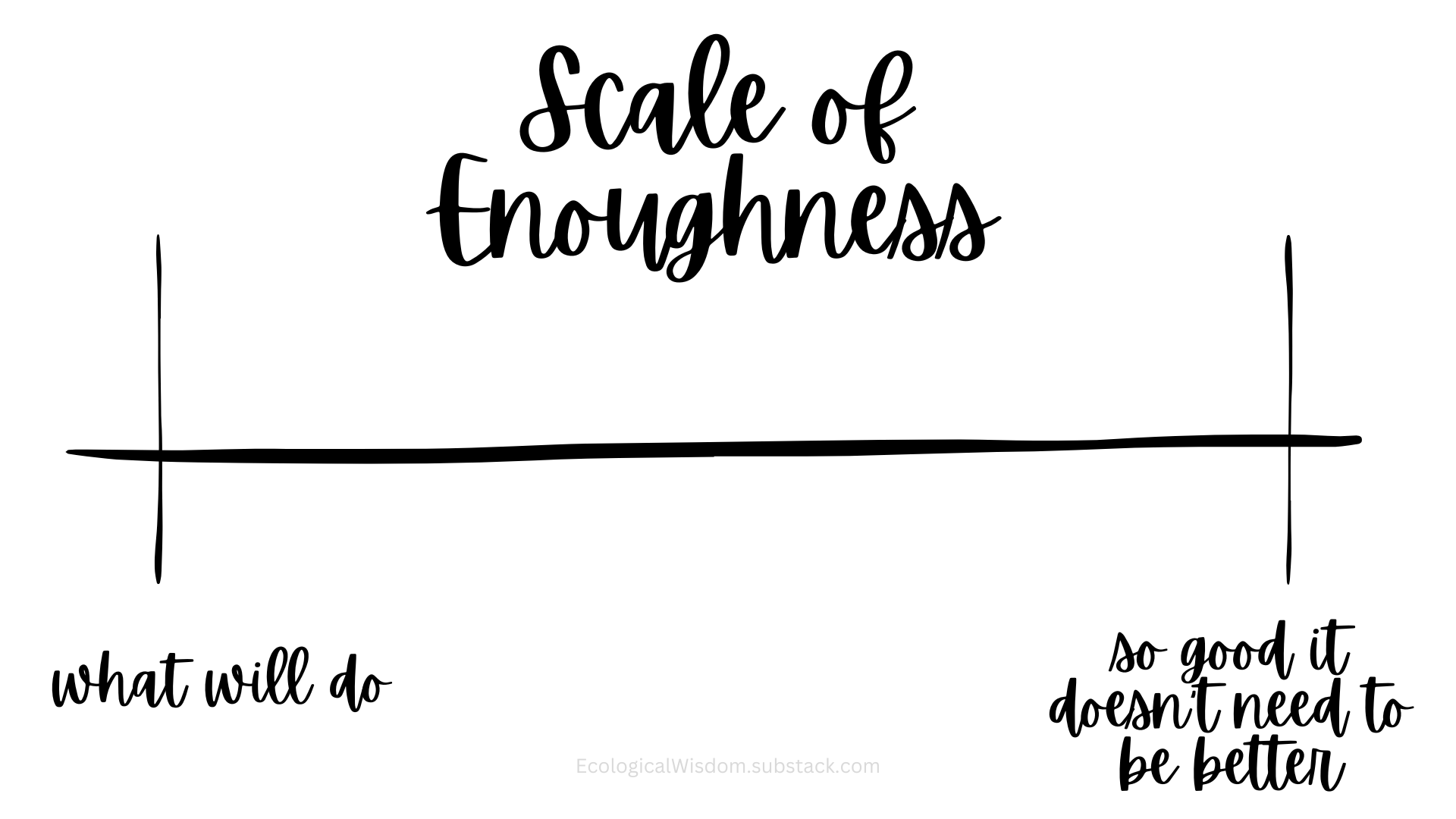
This sense of enoughness draws its strength from the intrinsic value of a situation. A meal, for instance, might not be objectively perfect or comparable to a dish prepared by a professional chef, but in the moment of enoughness, it is just right. The joy lies in the experience itself—the taste, the memories it evokes, the comfort it provides—not in how it stacks up against an idealised version of what it could be. Enoughness, in this sense, is context-bound and subjective, rooted in the absence of a desire for something greater.
At its core, enoughness is about presence. It requires being fully connected to the moment, whether that’s standing at the edge of the ocean, gazing at a stunning landscape, or sharing a simple, meaningful conversation with a loved one. In these moments, comparisons and aspirations fade away, replaced by a deep sense of satisfaction. Nature often provides us with easy access to enoughness, as do moments of connectedness with others. These experiences remind us of the richness available in the present, without the need for constant improvement or accumulation.
This perspective is not only valuable on a personal level but also on a societal and ecological one. A culture of "more" has contributed to significant social and environmental issues, including inequality and ecological degradation. In contrast, the philosophy of enoughness aligns closely with movements like degrowth, which advocate for a departure from consumerism and an emphasis on sustainability. Indigenous cultures have long practiced a form of enoughness, where sufficiency and sustainability go hand in hand, fostering compassion, solidarity, and ecological balance.
In a world obsessed with growth, optimisation, and maximisation, enoughness offers a liberating shift. It encourages us to pause and ask: What truly nurtures us? What do we really value? Instead of measuring our lives against external standards, enoughness invites us to return to an unmediated relationship with our experiences—one that is rich, whole, and complete in its own right. By embracing enoughness, we can cultivate a more peaceful, compassionate, and sustainable way of living—both for ourselves and for the world around us.
Adopting a mindset of enoughness doesn’t just offer a path for greater contentment and a more sustainable lifestyle, it also offers profound shift in how we might realise abundance in our social justice movements.
Collective Enoughness: a Methodology for Abundant Thinking
Collective enoughness is a philosophy, practice, and process, that helps us to realise that in this interconnected and interdependent world, together we have everything we need. When our work and our lives are rooted in that core assumption, we are being the world we want to see. And that is when magic can happen.
Collective Enoughness: The economic theory that together we have everything we need; it is only on our own that we experience scarcity.Catalytic Thinking is a theory rooted in the philosophy of abundance, initially proposed by Hilde Gottlieb, and Catalytic Thinking revolves around three intertwined observations that form the foundation of its approach to positive social change:
The Power of Causality: Our power to create powerful results lies in our power to create favourable cause-and-effect conditions towards those results.
The Power of People: It’s always about the people; it’s never about the “thing.” The most favourable conditions we can create are those that bring out the best in people vs. focusing on stuff.
The Power of Collective Enoughness: Together we have everything we need; it is only on our own that we experience scarcity.
Catalytic thinking enables us to operationalise the power of collective enoughness, that urges us to reframe the questions we ask, in order to better enable a fostering of collaboration. In action, these three observations remind us that:
We must shift from merely reacting to symptoms, to sharpening our focus on identifying and addressing the root causes that fuel societal issues.
While resources are essential, it’s the people themselves who drive change, foster innovation, and execute solutions.
When we truly acknowledge that together, we possess all that is needed, and we realise that it is in unity that we transcend scarcity, tapping into an abundance that elevates our shared goals and aspirations.
Catalytic Thinking hinges on the premise that our thoughts mold our actions. By posing questions grounded in abundance rather than scarcity, we unlock a stream of innovative and effective solutions. For instance:
Instead of asking: What is the problem and how will we solve it?
Catalytic thinking asks: What is the future we want to create, and what will it take to create that reality?
Instead of asking: Can we trust them? What if they steal my idea / our stuff?
Catalytic thinking asks: Who else cares about this? What can we accomplish together that none of us can accomplish on our own?
Instead of asking: How will we pay for that? Where will the money come from?
Catalytic thinking asks: What resources do we have together that none of us has all of on our own?
Listen to the podcast episode I did on Catalytic Thinking for Social Changemakers if you’re keen to learn more about how this applies to our social impact work.
There are three questions you can ask to get to the core of catalytic thinking:
What do we really want? → Why? → what will that make possible? → for whom?
Who else cares about this?
What do we have together?
Catalytic Thinking challenges the traditional mindset of resource scarcity, without forcing us into a mindset of abundance as needing more or excess, but rather one that recognises the abundant potential the exists when we come together and collaborate, allowing us to realise that together, we have enough. As Hilde says, “when we change the way we see things, things change.”